Have you ever seen your paycheck and noticed the term “time and a half”? Maybe your boss mentioned it, or you saw it in a job description, and you wondered, “What does this really mean?” You’re not alone. Many people search for “what does time and a half mean” because it can be confusing if you’re not familiar with payroll terms.
This guide explains exactly what time and a half means, when it applies, how to calculate it, real-life examples, and FAQs so you’ll never be confused again.
Quick Answer:
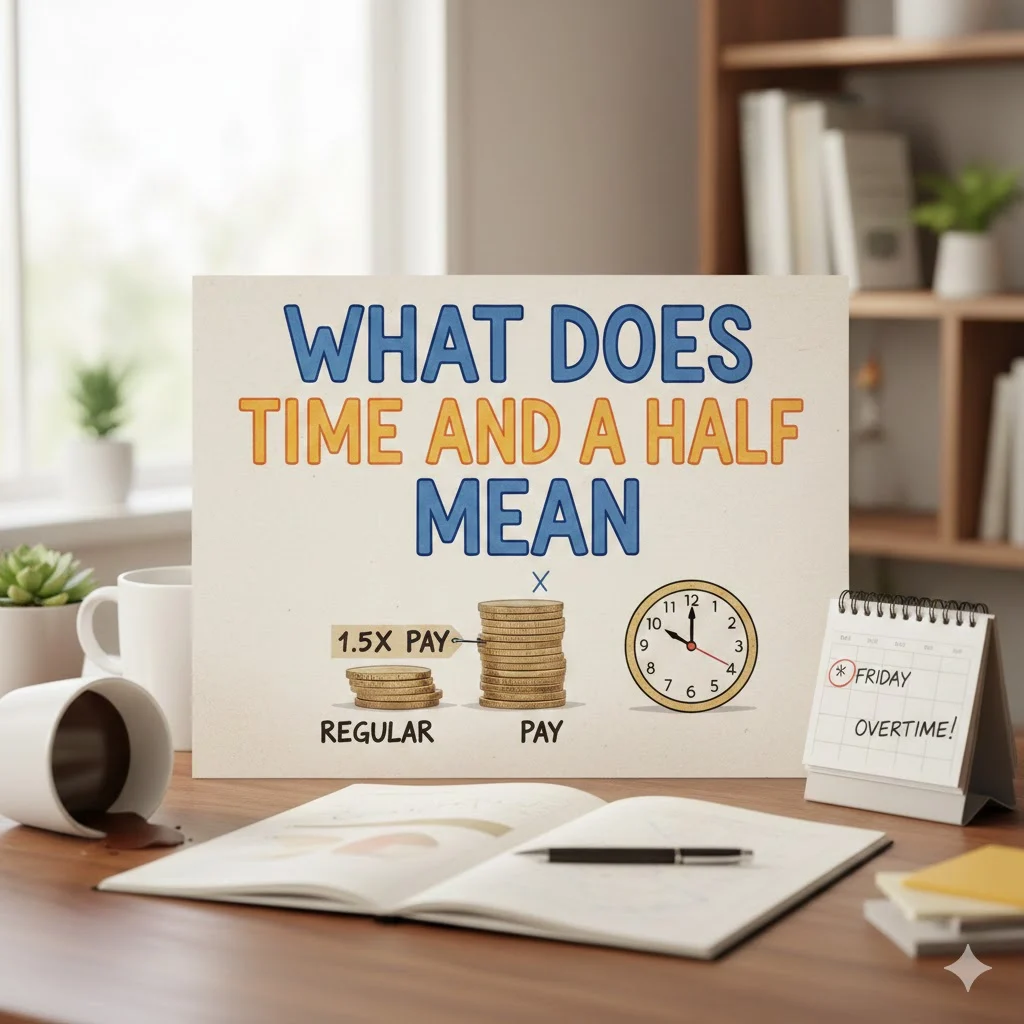
Time and a half means 1.5 times your regular hourly pay. It’s a fair pay practice used when employees work overtime, holidays, or special hours.
🧠 What Does Time and a Half Mean?
Time and a half is a payment method that gives employees one and a half times their usual hourly wage for each hour worked beyond a standard schedule.
Example:
- If your hourly rate is $20/hour, then time and a half would be: $20 × 1.5 = $30/hour
So, if you work 2 extra hours, you earn 2 × $30 = $60 instead of the normal $40.
In short:
Time and a half = 1.5 × regular hourly pay = Overtime or special pay rate.
This ensures employees are fairly compensated for extra hours worked.
📱 Where Is Time and a Half Commonly Used?
Time and a half is most common in workplace and payroll settings, including:
- 🏢 Hourly jobs – Retail, restaurants, hospitality
- 🏗️ Construction & labor – Overtime pay for extra shifts
- 🏥 Healthcare – Nurses, medical staff on holidays
- 💻 Corporate jobs – Certain overtime-eligible positions
- ⚖️ Unionized workplaces – Contracts often guarantee it
Tone: Professional and legal; it’s not casual slang. Employees use it to understand pay expectations.
💬 Examples of Time and a Half in Action
- Retail Store:
A: I have to work 4 extra hours tonight.
B: Don’t forget, that’s time and a half! - Restaurant:
A: Do I get paid more on the holiday shift?
B: Yes, all hours are at time and a half. - Healthcare:
A: My overtime this weekend counts as time and a half, right?
B: Correct, 1.5× your regular rate. - Construction:
A: I’m clocking 10 hours today.
B: The extra 2 hours are time and a half. - Office Work:
A: Worked 3 hours after 5 PM.
B: That’s 3 hours at time and a half.
🕓 When to Use and When NOT to Use Time and a Half
✅ When to Use Time and a Half
- Working overtime beyond 40 hours/week
- Working holidays or weekends (if your company policy allows)
- Shift differentials that qualify for extra pay
- Union contracts specifying overtime pay
- Temporary projects requiring extra hours
❌ When NOT to Use Time and a Half
- Regular scheduled hours within 40-hour workweek
- Paid vacation or sick leave (usually regular pay)
- Internships or unpaid work
- Freelance or contract work without overtime agreements
- Commission-only pay without hourly base
📊 Comparison Table
| Context | Example Phrase | Why It Works |
|---|---|---|
| Retail Overtime | “Extra hours are paid at time and a half.” | Fair compensation |
| Office OT | “3 hours extra pay = 1.5× hourly rate.” | Clear, precise |
| Holiday Shift | “All holiday hours are time and a half.” | Motivates staff |
| Normal Hours | “8-hour day = regular rate.” | No overtime applied |
🔄 Similar Payroll Terms or Alternatives
| Term | Meaning | When to Use |
|---|---|---|
| Double Time | 2× hourly pay | Holidays, extreme overtime |
| Overtime | Hours above standard schedule | Time and a half or double time |
| Shift Differential | Extra pay for unpopular shifts | Night/weekend work |
| Premium Pay | Higher rate for special conditions | Emergency, holiday, or hazard pay |
| Regular Pay | Standard hourly rate | Normal schedule |
🙋♂️ FAQs About Time and a Half
1. What is time and a half pay?
It’s 1.5× your regular hourly rate for extra hours worked.
2. When does time and a half apply?
Typically for overtime, holidays, or special shifts depending on company policy.
3. How do you calculate time and a half?
Multiply your regular hourly rate by 1.5.
4. Is time and a half mandatory?
For hourly employees under labor laws in many countries, yes for overtime. Salaried employees may differ.
5. Can part-time workers get time and a half?
Yes, if they work over the weekly hour threshold set by law or company policy.
6. What’s the difference between time and a half and double time?
Time and a half = 1.5× pay, Double time = 2× pay.
📝 Mini Quiz – Test Your Knowledge
1. Time and a half means:
a) 1× hourly pay
b) 1.5× hourly pay ✅
c) 2× hourly pay
2. When is time and a half commonly used?
a) Regular hours
b) Overtime hours ✅
c) Paid vacation
3. How do you calculate time and a half for $24/hour?
a) $36/hour ✅
b) $24/hour
c) $48/hour
4. Which term is higher than time and a half?
a) Double time ✅
b) Regular pay
c) Shift differential
5. Time and a half is mostly:
a) Casual slang
b) Payroll term ✅
c) Birthday bonus
📝 Conclusion
Time and a half is a simple but important payroll concept. It ensures employees are fairly compensated for extra hours, holidays, or unusual shifts. Whether you’re new to a job or reviewing your paycheck, knowing that time and a half = 1.5× your hourly pay helps you understand your earnings and protects your rights. Always check company policies or labor laws for exact details, but the concept is universally recognized in most hourly work environments.