If you’ve ever bought whiskey, vodka, rum, or any strong spirit, you’ve probably noticed the term “proof” on the bottle. Many people wonder what it means, why it’s important, and how it affects drinking strength. Whether you’re a curious beginner, a casual drinker, or someone learning about alcohol labels, understanding what proof means in alcohol helps you make smarter and safer choices.
In this guide, we’ll break down the definition, history, calculation, usage, and global variations. You’ll also see tables, examples, and simple comparisons to make everything crystal clear.
Definition & Meaning of Alcohol Proof
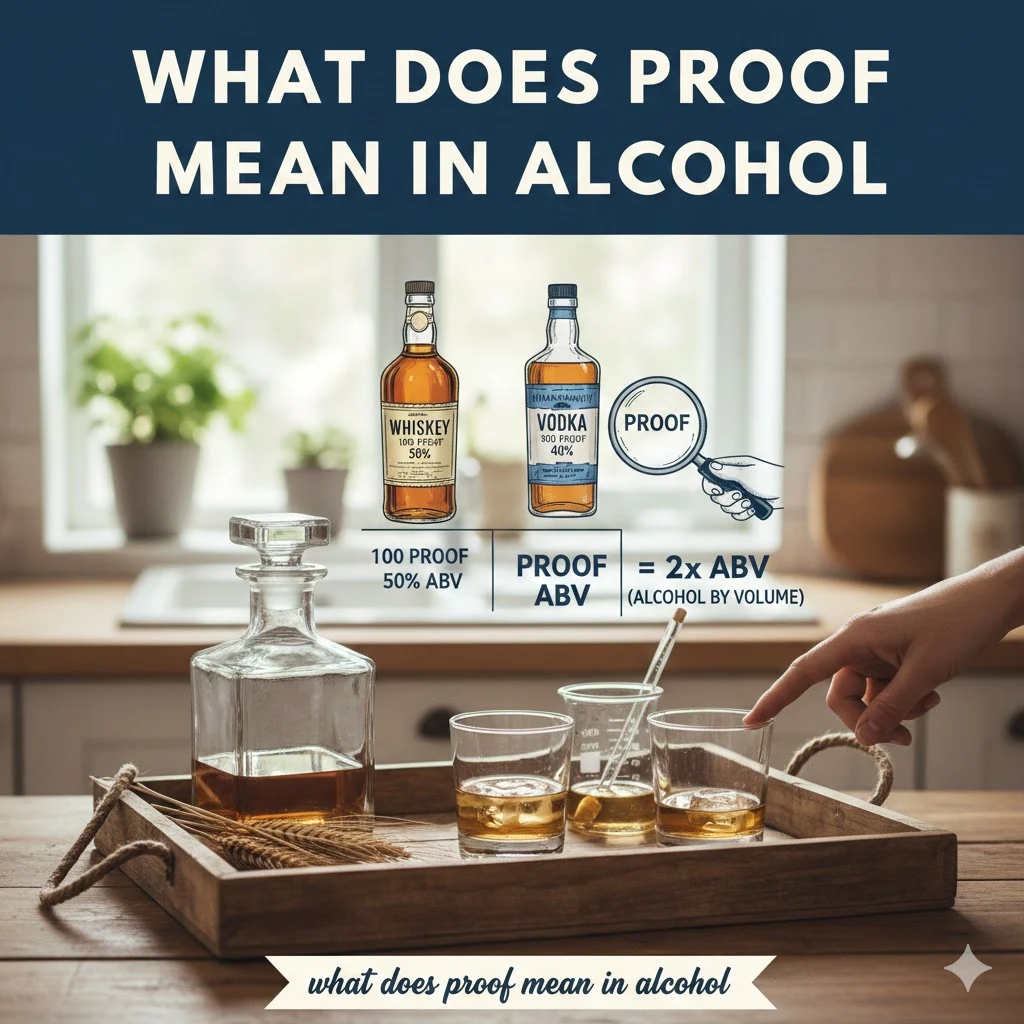
The term “proof” tells you how strong an alcoholic beverage is. It measures the ethanol (alcohol) content in a simple, easy-to-read number.
The Basic Rule (U.S. System):
Proof = Alcohol by Volume (ABV) × 2
Example:
- 40% ABV = 80 proof
- 50% ABV = 100 proof
Why Proof Exists
Proof helps consumers instantly understand how strong a drink is without doing math each time. It’s widely used on whiskey, rum, vodka, tequila, and other spirits.
Quick Examples
- A vodka bottle labeled 80 proof means 40% alcohol.
- A bourbon labeled 120 proof means 60% alcohol.
- A rum labeled 151 proof means 75.5% alcohol.
Key Points
- Higher proof = stronger alcohol.
- Proof does not appear on beer or wine because their strength is much lower.
- Proof is mainly used in the U.S.; other countries use ABV only.
Background & History
Understanding the story behind alcohol proof makes the concept easier to remember.
Where Did “Proof” Come From?
The term dates back to the 18th century, when the British government taxed alcohol based on strength. To “prove” the alcohol was strong enough, inspectors mixed gunpowder with spirits:
- If the gunpowder ignited, it was considered “proof.”
- If it didn’t, the alcohol was too weak.
This created the idea of proving the strength of alcohol.
Old British System
- 100 proof (UK) = about 57.15% ABV
- The British proof system is now outdated and rarely used.
Modern U.S. System
The U.S. created a simpler system:
Proof = 2 × ABV
This is the standard used today on almost all spirit bottles.
Why History Matters
- Helps explain why “proof” sounds like “testing strength.”
- Shows that modern proof numbers are simplified versions of older systems.
Usage in Different Contexts
1. Alcohol Bottles & Labeling
You’ll see proof on labels of:
- Whiskey
- Vodka
- Rum
- Gin
- Tequila
- Brandy
Example Label:
Jack Daniel’s Tennessee Whiskey — 80 Proof (40% ABV)
2. Cocktail Mixing
Proof helps bartenders:
- Balance flavors
- Adjust alcohol strength
- Control burn or smoothness
Example:
A 100-proof whiskey makes a stronger Old Fashioned than an 80-proof one.
3. Safety & Consumption
Higher proof drinks:
- Hit faster
- Warm the throat more
- Increase risk if consumed quickly
4. Cooking & Flaming Dishes
High-proof alcohol is used in:
- Flambé (like Bananas Foster)
- Fire cocktails
- Quick deglazing
Professional Communication
In bars, restaurants, and the beverage industry, “proof” is used in formal and technical ways.
Where You’ll Hear It
- Bartender training
- Distillery tours
- Alcohol certifications
- Menus and drink descriptions
Professional Example
“Please store all bottles above 100 proof in the secure cabinet.”
Appropriate Usage
- Discussing product strength
- Explaining safety rules
- Menu descriptions
- Comparing spirits
Not Appropriate
- Informal conversations where the listener may not know the term
- Medical or health discussions where ABV is clearer
- When talking to non-drinkers or minors
Safer Alternatives
Instead of “This is 120 proof,” say:
- “This is 60% alcohol.”
- “This is very strong; sip slowly.”
Hidden or Misleading Interpretations
“Proof” can sometimes cause confusion.
Common Misunderstandings
- Some people think proof is ABV.
- Others believe higher proof means “better” quality.
- Some confuse British and U.S. proof systems.
Clarifying with Examples
- Wrong: 80 proof = 80% alcohol
- Right: 80 proof = 40% alcohol
- Wrong: Higher proof means higher quality
- Right: Proof only measures strength, not taste or craftsmanship
Risks of High-Proof Alcohol
- Faster intoxication
- Higher dehydration
- Stronger throat burn
- More calories
Usage in Online Communities & Social Media
People often use “proof” casually in:
- Reddit discussions
- Alcohol review groups
- Bartender forums
- TikTok mixology videos
Typical Online Comments
- “This bourbon is 120 proof and still smooth!”
- “Any recommendations for high-proof rum for cocktails?”
- “Be careful—151 proof is no joke.”
Dating & Social Apps
Sometimes people mention proof when sharing:
- Favorite drinks
- Bar preferences
- Personal tastes
Example:
“I love 100-proof whiskey on weekends.”
Comparison with Similar Terms
| Term | Meaning | Used For | Notes |
|---|---|---|---|
| Proof | Alcohol strength (U.S.) | Spirits | Proof = ABV × 2 |
| ABV | Alcohol by Volume | All alcoholic drinks | Global standard |
| Percent Alcohol | Same as ABV | Labels & health info | Clear for beginners |
| Alcohol Content | General description | All drinks | Broad and non-technical |
Key Difference:
ABV is universal. Proof is mostly American.
10 Alcohol Terms Related to Proof
- ABV (Alcohol by Volume) – percentage of pure alcohol.
- High-Proof – usually 50%+ ABV.
- Cask Strength – bottled straight from barrel; often high proof.
- Overproof – stronger than the standard (e.g., 151 rum).
- Underproof – weaker than normal.
- Barrel Strength – similar to cask strength.
- Double Proof – slang for extremely strong spirits.
- Flammable Spirit – high proof that can ignite.
- Navy Strength – 57% ABV, inspired by naval history.
- Bonded (100 Proof) – legal U.S. requirement for bonded whiskey.
How to Respond When Someone Mentions Proof
Casual Responses
- “Oh, that’s strong!”
- “Nice. I like 80-proof stuff more.”
Curious Beginner
- “What’s the ABV on that?”
- “How does the proof affect the taste?”
Professional Setting
- “Please confirm the ABV for accuracy.”
- “Is that cask strength or standard proof?”
Safety-Conscious
- “Let’s pace ourselves; that’s pretty high proof.”
Regional & Cultural Differences
U.S.
- Uses Proof = ABV × 2
- Most common system today.
U.K. (Historical)
- Old UK proof (no longer used)
- 100 proof ≈ 57.15% ABV
Europe
- Uses ABV only.
- No proof labels.
Asia
- Japan uses ABV.
- India uses ABV for liquor and local variants.
Caribbean
High-proof rum is common, especially:
- 151 rum
- Overproof rum
FAQs
Q1: What does proof mean in alcohol?
It’s a number that shows alcohol strength. Proof = ABV × 2.
Q2: Why do spirits have proof but beer doesn’t?
Beer is too low in alcohol; only ABV is needed.
Q3: What is a high-proof alcohol?
Anything above 100 proof (50% ABV).
Q4: Is proof the same worldwide?
No. Only the U.S. uses the modern proof system.
Q5: What is the strongest alcohol?
Some spirits exceed 190 proof (95% ABV), like Everclear.
Conclusion
Understanding what proof means in alcohol helps you read labels more confidently, choose drinks wisely, and enjoy spirits safely. Proof simply shows how strong a drink is, using a number that’s double the ABV. Whether you’re mixing cocktails, learning about whiskey, or comparing rum strengths, knowing the proof keeps things simple. It also helps you make safer choices, especially when trying high-proof spirits. Now that you know how proof works, you can explore alcohol labels with clarity and confidence.