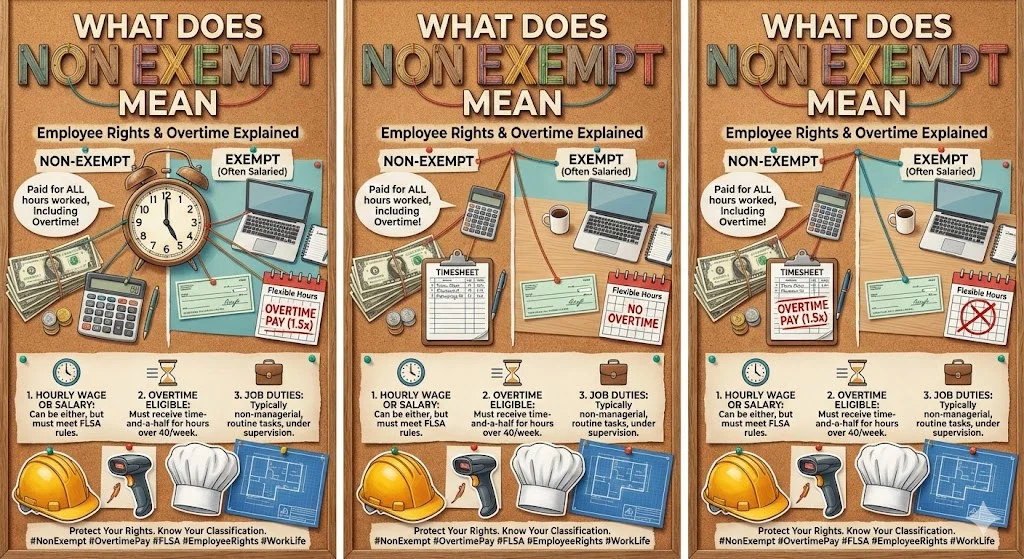
If you’ve ever reviewed a job offer, paycheck, or HR document, you may have seen the term non-exempt and felt confused. You’re not alone. Many employees don’t fully understand what it means, yet it directly affects pay, overtime, and work hours.
So, what does non-exempt mean exactly?
In simple terms, a non-exempt employee is someone who must be paid overtime when they work more than the standard number of hours per week. This classification is based on labor laws, not job titles.
This article breaks down the meaning of non-exempt in plain English. You’ll learn how it works, who qualifies, how it affects your paycheck, and why it matters—whether you’re an employee, manager, or business owner.
Definition & Meaning of Non-Exempt
The term non-exempt comes from labor laws, mainly the Fair Labor Standards Act (FLSA) in the United States.
Non-Exempt Meaning (Simple Definition)
A non-exempt employee is not exempt from overtime laws. That means:
- You must be paid overtime
- Overtime applies after 40 hours per week
- Overtime pay is usually 1.5× your regular rate
Key Points to Remember
- Non-exempt = overtime eligible
- Usually hourly, but can be salaried
- Time tracking is required
- Protected by wage and hour laws
Basic Example
You earn $20 per hour.
You work 45 hours this week.40 hours × $20 = $800
5 overtime hours × $30 = $150Total pay = $950
That’s what non-exempt means in real life.
Background & History of Non-Exempt Status
The concept of non-exempt employees started with labor reforms in the 1930s.
Why It Was Created
Before labor laws:
- Employees worked long hours
- No overtime pay
- Employers set unfair schedules
The Fair Labor Standards Act (1938) changed that by:
- Setting minimum wage
- Introducing overtime pay
- Defining exempt vs non-exempt workers
How the Term Evolved
Over time:
- Job roles changed
- Salaries increased
- New industries emerged
But the core idea stayed the same:
👉 Workers should be paid fairly for extra hours
Today, non-exempt status still protects millions of workers worldwide.
Non-Exempt vs Exempt Employees
This is where most confusion happens.
Quick Comparison Table
| Feature | Non-Exempt | Exempt |
|---|---|---|
| Overtime Pay | Yes | No |
| Hour Tracking | Required | Not required |
| Pay Type | Hourly or salary | Usually salary |
| Legal Protection | Strong | Limited |
| Common Roles | Retail, support, admin | Managers, executives |
Simple Explanation
- Non-exempt = paid for every extra hour
- Exempt = fixed salary, no overtime
Your job duties, not your title, decide this.
How Non-Exempt Employees Are Paid
Non-exempt employees can be paid in two ways:
1. Hourly Pay
- Most common
- Paid per hour worked
- Overtime is automatic
2. Salaried Non-Exempt
Yes, this exists.
- Fixed weekly salary
- Still eligible for overtime
- Hours must be tracked
Important Note
Being salaried does NOT automatically mean exempt.
Overtime Rules for Non-Exempt Employees
Overtime is the biggest benefit of non-exempt status.
Standard Overtime Rules
- Applies after 40 hours per week
- Paid at 1.5× regular rate
- Some states have daily overtime rules
Examples
- $15/hour → overtime = $22.50/hour
- $25/hour → overtime = $37.50/hour
Can Employers Avoid Overtime?
No.
- Overtime is a legal right
- Employers cannot waive it
- “Off-the-clock” work is illegal
Usage in Workplace & HR Contexts
You’ll often see “non-exempt” in:
- Job descriptions
- Offer letters
- Employee handbooks
- Payroll systems
Typical Job Posting Line
“This position is classified as non-exempt and eligible for overtime pay.”
This means:
- Hour tracking required
- Extra pay for extra hours
Professional Communication & Non-Exempt Status
In professional settings, the term is formal and legal.
Appropriate Use
- HR emails
- Contracts
- Payroll discussions
Inappropriate Use
- Casual chats without explanation
- Using it as a job title
Better Alternatives (When Explaining)
- “Overtime-eligible employee”
- “Hourly position with overtime”
Common Myths About Non-Exempt Employees
Let’s clear up confusion.
Myth 1: Non-Exempt Means Low-Level
❌ False
Many skilled roles are non-exempt.
Myth 2: Salaried Means Exempt
❌ False
Salary alone doesn’t decide status.
Myth 3: Managers Are Always Exempt
❌ False
Duties matter more than title.
Non-Exempt Status in Different Industries
Non-exempt roles appear across industries.
Common Examples
- Retail associates
- Customer service reps
- Administrative assistants
- Technicians
- Healthcare staff
- Manufacturing workers
Why It Varies
Each industry applies labor laws differently based on:
- Job duties
- Authority level
- Pay structure
Regional & Cultural Differences
Non-exempt is mostly a U.S. legal term, but similar concepts exist elsewhere.
United States
- Governed by FLSA
- Clear exempt vs non-exempt rules
Canada
- Uses “overtime eligible”
- Provincial labor laws
UK & Europe
- Focus on working time regulations
- Less use of the term “non-exempt”
Always check local labor laws.
How to Know If You Are Non-Exempt
Ask yourself:
- Do I get paid overtime?
- Do I track hours?
- Am I paid hourly?
- Does my contract mention overtime eligibility?
Best Way to Confirm
- Ask HR
- Review your offer letter
- Check local labor laws
How to Respond If Asked About Your Status
Professional Response
“I’m classified as a non-exempt employee and eligible for overtime.”
Casual Response
“I’m hourly, so I get overtime.”
When Unsure
“I’ll confirm my classification with HR.”
FAQs About Non-Exempt Meaning
Q1: What does non-exempt mean in simple terms?
It means you get paid overtime for extra hours worked.
Q2: Can a non-exempt employee be salaried?
Yes, but overtime still applies.
Q3: Is non-exempt better than exempt?
It depends. Non-exempt offers overtime pay; exempt offers salary stability.
Q4: Can my employer change my status?
Yes, but only if job duties and legal criteria change.
Q5: Is non-exempt the same worldwide?
No. Rules vary by country.
Conclusion
Understanding what does non-exempt mean is essential for protecting your pay and rights at work. A non-exempt employee is legally entitled to overtime pay, proper hour tracking, and fair compensation for extra work. This status isn’t about rank or importance—it’s about labor law protection. Whether you’re starting a new job, reviewing a contract, or managing employees, knowing the difference between exempt and non-exempt helps avoid costly mistakes. Stay informed, ask questions, and always check your classification to ensure you’re being paid correctly.
Discover More:-
- What Does Deku Mea? | Definition, Origins & Usage
- What Does the Color Blue Mean: Symbolism, Psychology & Usage