You’ve probably seen a small sign on someone’s door or window that reads “No Soliciting.” Maybe you saw it outside a business. Maybe you came across it while shopping or delivering something. But what does it actually mean? And why do people use it?
In today’s world, where strangers can show up for sales, promotions, charity drives, political campaigns, surveys, and door-to-door marketing, the phrase “No Soliciting” helps set clear boundaries.
This guide explains what “No Soliciting” means, how it’s used in homes and businesses, legal details, examples, cultural differences, and even how to respond politely.
Definition & Meaning of “No Soliciting”
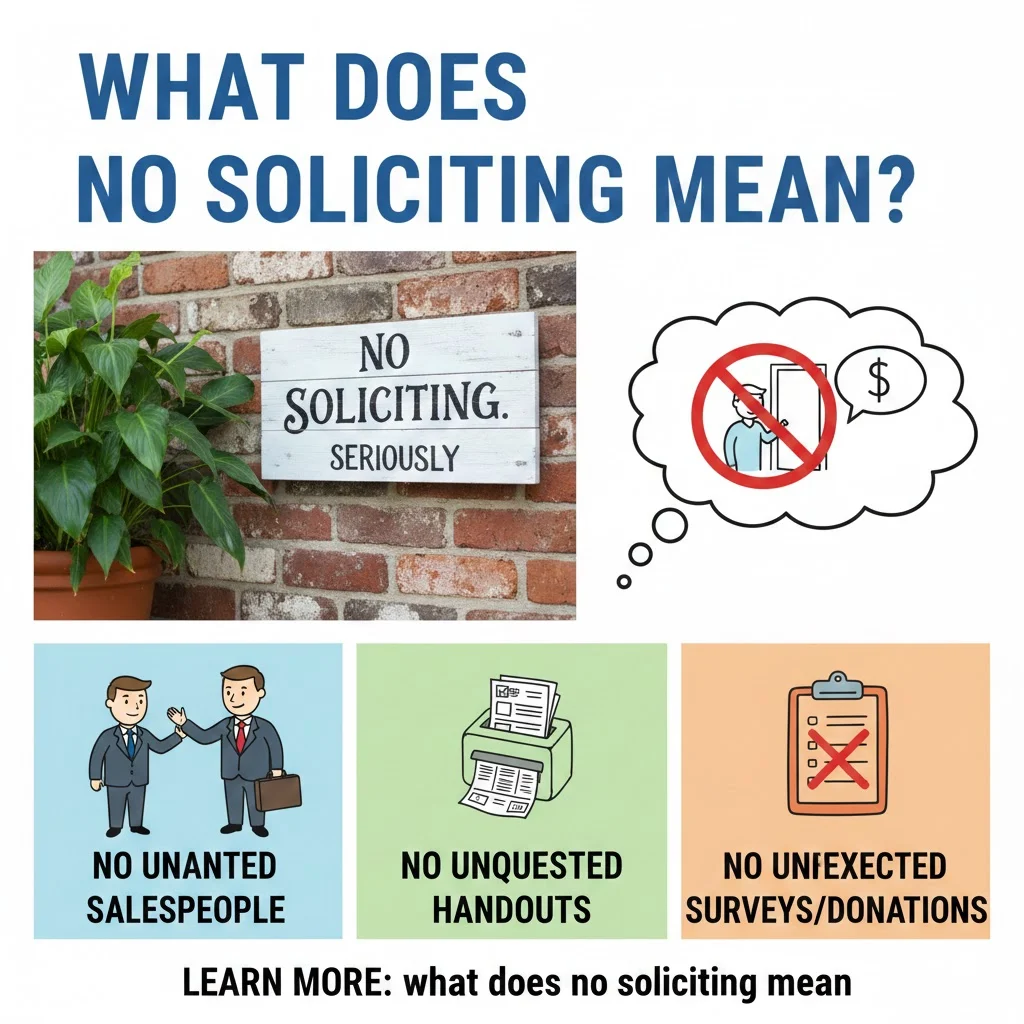
“No Soliciting” simply means no one should approach the property to ask for anything. Asking can include:
- Selling products
- Promoting services
- Fundraising
- Sharing religious or political messages
- Asking for donations
- Passing out flyers
- Surveying
Core meaning:
👉 Do not knock, ring the bell, or approach the property to request money, support, signatures, or attention.
Examples
At a home:
A door sign says: “No Soliciting.”
A salesperson should not knock to sell a vacuum.
At a business:
A store displays “No Soliciting.”
No promotions, fundraising, or leaflet distribution allowed.
Why people put the sign
- To avoid interruptions
- For privacy
- To prevent scams
- To stop unwanted sales visits
- For safety
- To reduce noise
Important Note
“No Soliciting” does not usually stop:
- Delivery drivers
- Postal workers
- Friends and family
- Emergency responders
These are not considered solicitors.
Background & History
The phrase “No Soliciting” became common as door-to-door sales grew in the early 1900s. Companies sent sales staff directly to homes. Many people didn’t enjoy these visits.
Over time, charities, political campaigns, religious groups, and independent sellers also started door-knocking. This led homeowners and businesses to use signs to protect their space.
Key developments
- Early 1900s: Door-to-door sales were normal.
- Mid-1900s: People grew annoyed by unsolicited pitches.
- Late 1900s: Cities passed rules to limit aggressive soliciting.
- Modern era: Signs became a common privacy tool.
Digital influence
Today, the idea of “No Soliciting” is also seen online:
- Websites request “No unsolicited offers.”
- Social media bios say “No DMs for business.”
The meaning stays the same: don’t ask without permission.
Usage in Different Contexts
“No Soliciting” can appear in many places. Its meaning can shift slightly depending on the location.
1. Homes
Most people place signs to stop:
- Salespeople
- Religious visitors
- Political canvassers
- Fundraisers
- Survey takers
Example:
“No Soliciting. We do not buy at the door.”
2. Businesses
Shops and offices use it to avoid:
- Product promotions
- Flyer distribution
- Donation requests
- Vendor pitches
Example:
“No Soliciting — No Sales, No Flyers, No Surveys.”
3. Apartments & HOAs
These areas may ban soliciting entirely for:
- Safety
- Resident comfort
- Reduced foot traffic
4. Online & Emails
“No Soliciting” can show up as:
- “No unsolicited messages.”
- “No sales emails.”
- “No business DMs.”
Quick Table
| Setting | Meaning | Example |
|---|---|---|
| Home | No door-to-door requests | “No salespeople.” |
| Business | No promos or fundraising | “No advertising.” |
| Online | No cold messages | “No business inquiries.” |
| HOA/Apartment | Restricted entry for promoters | “No canvassing allowed.” |
Professional Communication
When used professionally, “No Soliciting” protects time and space.
When businesses use it
Do Not Approach for:
- Selling anything
- Offering marketing services
- Asking for sponsorship
- Requesting donations
- Promoting personal business
Professional example:
“Please respect our workspace. No soliciting inside the building.”
Why workplaces use it
- Prevent interruptions
- Protect employees
- Maintain safety
- Reduce clutter
- Avoid aggressive sales tactics
Polite alternatives to say the same thing
- “We are not accepting sales inquiries.”
- “We do not engage in unsolicited offers.”
- “Please schedule or email before visiting.”
These sound friendly but keep boundaries clear.
Hidden or Confusing Meanings
Sometimes people misunderstand “No Soliciting.” Here are common confusions:
❌ Misunderstanding:
“It means no talking to the house owner.”
Reality:
It only blocks requests, not friendly visits.
❌ Misunderstanding:
“It bans deliveries.”
Reality:
Delivery drivers are welcome.
❌ Misunderstanding:
“It stops neighborhood kids from selling cookies.”
Reality:
Some families still allow it, but others don’t.
Risky Interpretations
Some might think soliciting includes:
- Asking for help
- Offering advice
- Saying hello
It doesn’t. Soliciting always involves asking for something that benefits the requester.
Safe Interpretation
If you’re unsure, always assume:
👉 Do not knock unless you are invited or expected.
Usage in Online Communities & Dating Apps
The phrase appears online too, with a modern twist.
On Social Media
People use it to prevent:
- Unwanted promotions
- Crypto pitches
- Collaboration requests
- Random business messages
Bio example:
“No soliciting. No promo DMs.”
In Dating Apps
People use it to avoid:
- Business recruiters
- Multi-level marketing pitches
- Spam offers
- Selling or promoting services
Profile example:
“Here to meet people, not buy things. No soliciting.”
In Online Communities
Moderators use “No Soliciting” to keep spaces safe from spam.
Examples include:
- Discord servers
- Facebook groups
- Reddit communities
Common rules:
- No selling
- No self-promotion
- No advertising
- No recruiting
Comparison with Similar Terms
Some signs look similar but mean different things.
Table of Similar Terms
| Term | Meaning | Difference |
|---|---|---|
| No Soliciting | No requests or sales | Broadest term |
| No Trespassing | No entering property | Legal boundary |
| No Loitering | No standing around aimlessly | Behavior-based |
| No Canvassing | No political or survey visits | Specific kind of soliciting |
| No Salespeople | No selling at the door | Narrower than “No Soliciting” |
Key difference:
“No Soliciting” covers all uninvited requests.
10 Signs & Phrases Related to “No Soliciting”
Below are common variations with their meanings:
- No Soliciting — We Don’t Buy at the Door
– Blocks sales visits. - No Soliciting — No Exceptions
– Very strict boundary. - No Solicitation or Distribution
– No flyers, papers, or handouts. - No Canvassing or Soliciting
– Blocks political or charity visits. - No Sales, No Surveys, No Donations
– Complete shut-down of all requests. - Please Do Not Knock or Solicit
– Friendly but firm. - No Unsolicited Messages
– Common in email or social profiles. - No Commercial Solicitation
– For businesses to avoid vendors. - No Promotion or Advertising
– Used online or in stores. - No Fundraising or Door-to-Door Visits
– Common in apartments.
How to Respond to a “No Soliciting” Sign
Your response depends on your role.
If you are a salesperson
- Do not knock.
- Respect the sign.
- Leave quietly.
If you are delivering
You may proceed. It’s not soliciting.
Example:
Walk up, drop package, leave. No knocking needed.
If you are a friend
You can knock because you’re not selling anything.
If the sign seems unclear
You can silently leave a card in the mailbox (if legal).
Do not knock unless invited.
Polite Respectful Response (If needed)
- “Understood, have a great day.”
- “No worries, I won’t disturb you.”
- “I’ll make sure not to approach next time.”
Regional & Cultural Differences
Meaning stays mostly the same worldwide, but usage varies.
United States
“No Soliciting” is everywhere—homes, stores, offices.
Very common due to heavy door-to-door activity.
United Kingdom
More gentle wording is used:
- “No Cold Callers”
- “No Salespeople Please”
Canada
Used mostly in suburbs and apartment areas.
Australia
Less common, but businesses use:
- “No Hawkers” (older term)
- “No Door Knockers”
Asia
Usually written as:
- “No Sales”
- “Do Not Disturb”
- “No Promotion”
Middle East
Businesses use:
- “No Advertisement”
- “No Sales Visits”
Meaning everywhere is similar:
👉 Do not request anything without permission.
FAQs
1. Can delivery people ignore a No Soliciting sign?
Yes. Deliveries are not soliciting.
2. Does No Soliciting stop religious visits?
Usually yes, unless local laws say otherwise.
3. Is it illegal to ignore a No Soliciting sign?
Varies by region. Some places fine persistent solicitors.
4. Does No Soliciting apply to political campaigns?
Often yes. Some areas classify canvassing as soliciting.
5. Can I put a No Soliciting sign on an apartment door?
Yes, unless the building has its own rules.
6. Does No Soliciting stop neighborhood kids selling cookies?
Sometimes. Depends on the homeowner.
7. Can solicitors leave brochures on the doorstep?
Some areas allow it; others treat it as solicitation.
Conclusion
“No Soliciting” is a simple way for homeowners and businesses to protect their space, time, and privacy. It blocks unwanted sales, promotions, surveys, and fundraising visits. Understanding what the sign means helps you act respectfully and avoid uncomfortable situations. Whether you’re delivering, visiting, or running a business, recognizing these boundaries makes communication smoother and more polite. If you ever see a “No Soliciting” sign, assume the person wants peace and privacy—and honoring that shows professionalism and courtesy.