Have you ever heard a lawyer or TV show mention someone pleading “no contest” in court and wondered what it really means? It can be confusing, especially when you’re trying to understand legal terms.
This article explains what a “no contest” plea is, how it differs from guilty or not guilty, when it’s used, examples, and what it means for defendants and the legal process. By the end, you’ll know exactly what happens when someone pleads “no contest” in court.
Quick Answer:
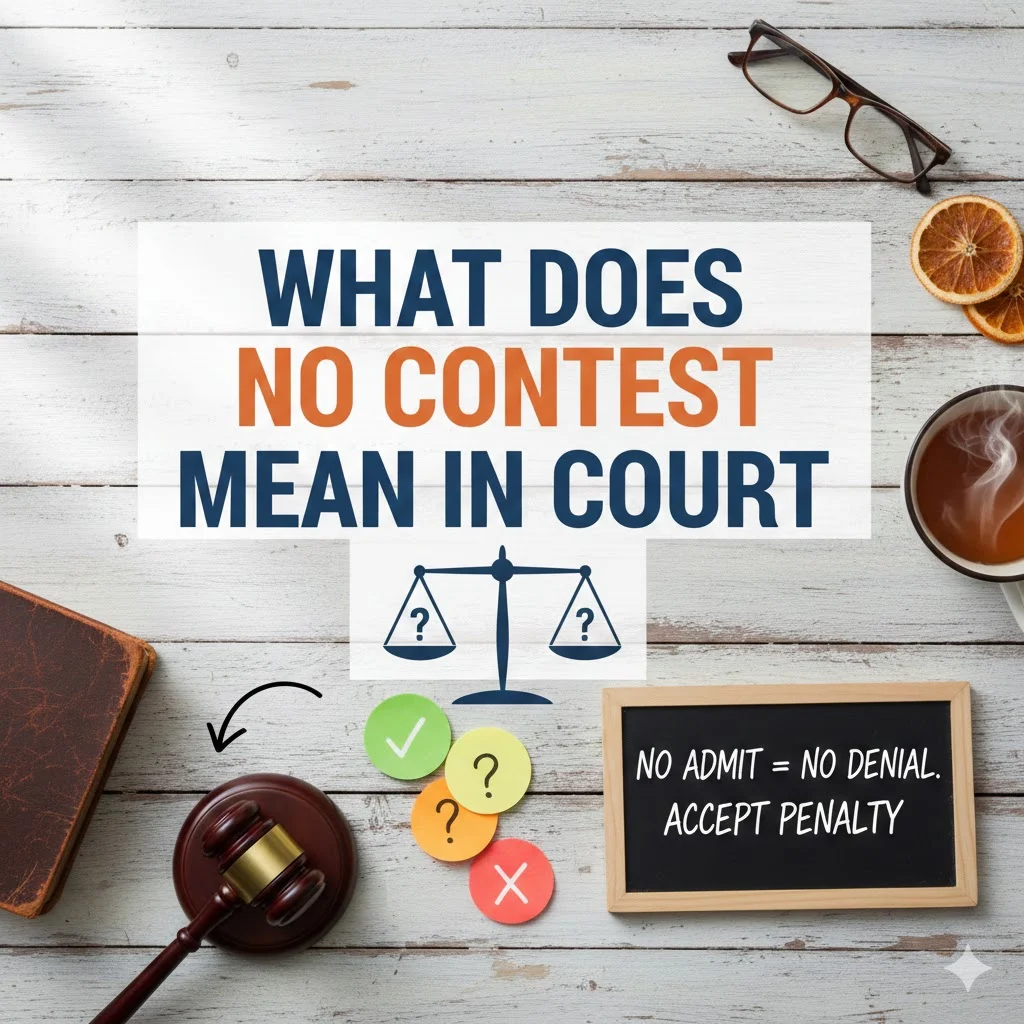
A no contest plea means a defendant does not admit guilt but accepts the punishment. It’s a neutral legal stance that avoids an admission of guilt in civil court while allowing criminal sentencing.
🧠 What Does No Contest Mean in Court?
A no contest plea, or nolo contendere, allows a defendant to accept conviction without admitting guilt.
- In criminal court, it is treated similarly to a guilty plea for sentencing.
- In civil court, it cannot usually be used as evidence of liability.
Example in a sentence:
“The defendant pleaded no contest to the charges, avoiding a trial but accepting the court’s sentence.”
In short:
No Contest = Nolo Contendere = Accepts punishment without admitting guilt.
It’s often used to protect defendants from civil liability while still resolving criminal cases efficiently.
📜 How a No Contest Plea Works
- Defendant chooses no contest instead of pleading guilty or not guilty.
- Court accepts the plea (judge approval is required).
- Sentencing occurs just as it would with a guilty plea.
- Civil lawsuits: The plea usually cannot be used as proof of guilt.
Legal Tip: A no contest plea is only available in criminal cases, and rules vary by jurisdiction.
⚖️ Why Would Someone Plead No Contest?
- To avoid admitting guilt publicly.
- To reduce risk in civil lawsuits.
- To speed up court proceedings without going to trial.
- Sometimes part of a plea bargain with the prosecutor.
Example:
“He pleaded no contest to the misdemeanor to avoid an extended court trial and potential civil claims.”
💬 Examples of No Contest in Court
- Criminal Case:
Defendant charged with theft → pleads no contest → judge imposes sentence
- Traffic Violation:
Reckless driving → no contest plea → pays fine, avoids admission of guilt
- Domestic Case:
Minor assault → no contest → serves sentence but cannot be used against in civil claims
- High-profile example:
Celebrity legal case → no contest plea → avoids trial while accepting sentencing
- DUI Case:
Defendant pleads no contest → court imposes DUI penalties without admitting guilt
🕓 When to Use and When NOT to Use a No Contest Plea
✅ When to Use
- Minor offenses or misdemeanors
- Cases with possible civil liability
- Plea bargains for lesser sentences
- Wanting to avoid trial costs and duration
❌ When Not to Use
- Serious crimes with long-term consequences
- Cases where admission of guilt may help plea negotiations
- When the defendant wants to contest charges fully
- Situations where a no contest plea is not allowed by law
Comparison Table
| Context | Example Phrase | Why It Works |
|---|---|---|
| Minor Offense | “No contest to the ticket.” | Resolves case quickly, minimal risk |
| Civil Risk | “No contest plea to charges.” | Protects against civil liability |
| Criminal Case | “Pled no contest to misdemeanor.” | Efficient legal resolution |
| Trial Scenario | “Pled not guilty, went to trial.” | For contesting charges |
🔄 Similar Legal Terms or Alternatives
| Term | Meaning | When to Use |
|---|---|---|
| Guilty Plea | Admit guilt | Criminal sentencing, civil exposure |
| Not Guilty | Deny charges | Prepare for trial, contest evidence |
| Alford Plea | Maintain innocence but accept punishment | Similar to no contest in some states |
| Deferred Adjudication | Delay or reduce conviction | Minor offenses, probation option |
| Plea Bargain | Agreement with prosecutor | Reduce charges or sentence |
🙋♂️ FAQs About No Contest
1. Is no contest the same as guilty?
No. It avoids admitting guilt but has similar sentencing outcomes.
2. Can a no contest plea be used in civil court?
Usually not; that’s the main advantage for defendants.
3. Is a no contest plea common?
Yes, especially in minor criminal cases and plea deals.
4. What is nolo contendere?
It’s the Latin term for no contest.
5. Can someone appeal after a no contest plea?
Yes, but appeals are more limited than after a not guilty plea.
6. Does pleading no contest affect a criminal record?
Yes, it generally results in a conviction on record, similar to a guilty plea.
📝 Mini Quiz – Test Your Knowledge
1. What does a no contest plea mean?
a) Admit guilt and go to trial
b) Accept punishment without admitting guilt ✅
c) Deny charges entirely
2. What is the Latin term for no contest?
a) Nolo contendere ✅
b) Habeas corpus
c) Pro bono
3. Can a no contest plea be used in civil court as evidence?
a) Usually no ✅
b) Always
c) Only in federal court
4. Why might someone choose no contest?
a) Avoid civil liability ✅
b) Admit guilt publicly
c) Delay trial indefinitely
5. Which type of cases often allow no contest pleas?
a) Minor offenses and misdemeanors ✅
b) Capital crimes
c) Tax fraud only
📝 Conclusion
A no contest plea allows defendants to accept punishment without admitting guilt, providing a legal strategy that can protect against civil liability and avoid lengthy trials. Understanding this term is crucial for anyone following court cases or navigating the criminal justice system. By knowing when and why a no contest plea is used, you can better understand courtroom decisions, legal strategies, and the balance between criminal and civil consequences.