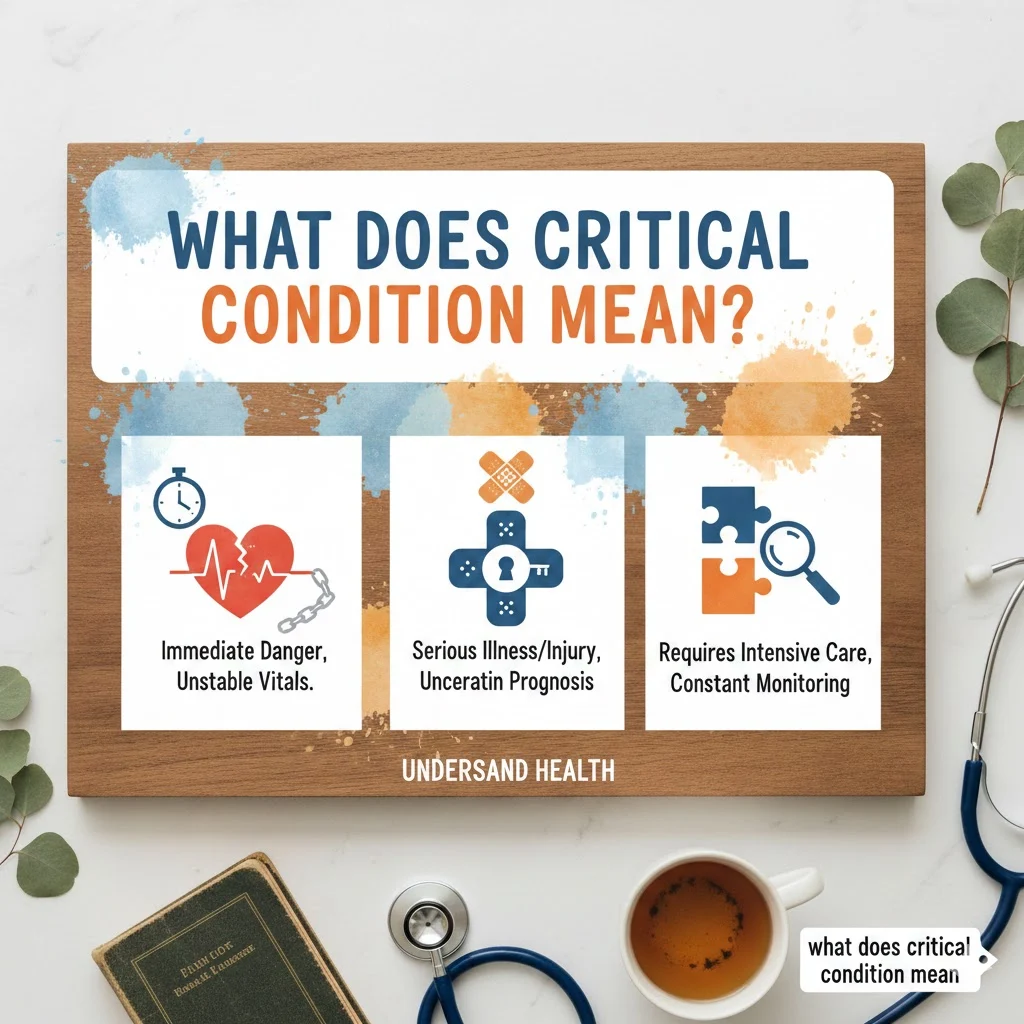
If you’ve ever heard someone say a patient is in critical condition, you may have wondered exactly what that means. This term is widely used in medical settings, news reports, and emergency updates, but it can be confusing for non-medical readers.
In this article, we’ll explain what critical condition means, explore its implications, share examples, and guide you on how to interpret it in different situations. Whether you’re reading the news, chatting with friends, or discussing health topics, understanding this term is important for clear communication.
Definition & Meaning of Critical Condition
Critical condition is a medical term used to describe a patient whose health status is severely unstable and life-threatening.
Key Points:
- The patient’s vital signs are unstable and not within normal ranges.
- Immediate and intensive medical care is required.
- There is a significant risk to life if conditions do not improve.
Examples in Context:
News report:
“The actor was hospitalized last night and is currently in critical condition.”
Hospital context:
Nurse: “Mr. Thompson is in critical condition; we are monitoring his vitals constantly.”
Common Misunderstandings:
- Critical condition ≠ death: It means the patient is very ill, but survival is still possible.
- Critical condition ≠ stable condition: Stable patients are not in immediate danger.
Background & History
The term critical condition has been part of medical terminology for decades. It is commonly used by hospitals, emergency medical services, and media outlets.
- Origin: Derived from Latin “criticus,” meaning decisive or crucial, indicating a turning point in health.
- Evolution: Hospitals standardized patient condition categories: stable, serious, critical, and deceased.
- Cultural influence: News media often report “critical condition” for high-profile cases, making it widely recognized beyond hospitals.
Usage in Different Contexts
Medical Context:
- Refers to patients in ICU or emergency care.
- Requires constant monitoring.
News & Media:
- Used to inform public without disclosing sensitive details.
- Example:
“The victim remains in critical condition after the accident.”
Everyday Use (Metaphorical):
- Sometimes used to describe urgent situations outside medicine.
- Example:
“The project is in critical condition; we must fix it immediately.”
Comparison Table:
| Term | Meaning | Context |
|---|---|---|
| Critical Condition | Life-threatening, unstable | Medical/emergency |
| Serious Condition | Significant but not immediately life-threatening | Medical |
| Stable Condition | Patient is stable with no immediate danger | Medical |
Professional & Emergency Communication
When talking about critical condition:
- Use caution: It’s a sensitive term in medical settings.
- Avoid exaggeration: Saying someone is “critical” outside medical context can cause panic.
- Alternatives for professionals: “Serious condition,” “stable but critical care required.”
Tips:
- Confirm information from reliable sources before sharing.
- Understand that critical condition indicates severity, not a prediction of death.
Hidden or Misleading Meanings
- Media sometimes uses “critical condition” for dramatic effect.
- Not all patients reported as critical are near death.
Safe Interpretation:
- Always consider the medical context.
- Avoid assumptions about survival outcomes.
Usage in News Reports & Public Statements
Tips for readers:
- Look for hospital updates for clarification.
- Understand the difference between critical, serious, and stable.
Dialogue example:
Friend: “Did you hear about the accident?”
You: “Yes, the driver is in critical condition, meaning they need intensive care.”
Comparison with Similar Terms
| Term | Meaning | Urgency | Example |
|---|---|---|---|
| Critical Condition | Life-threatening, unstable | Very high | “Patient in ICU, critical condition” |
| Serious Condition | Concerning but stable | Medium | “Patient serious but stable” |
| Stable Condition | Vitals normal, no immediate danger | Low | “Patient recovering, stable” |
10 Related Terms & Phrases
- ICU (Intensive Care Unit) – Where critical patients are treated.
- Life-threatening – Risk of death exists.
- Severe condition – High medical concern.
- Unstable vitals – Blood pressure, heart rate fluctuating dangerously.
- Emergency care – Immediate treatment required.
- Critical patient – Patient in critical condition.
- Medical alert – Notification about severe condition.
- On life support – Patient depends on machines to survive.
- High-risk patient – Increased chance of serious complications.
- Acute condition – Sudden and severe illness.
How to Respond
- Casual: “I hope they recover soon.”
- Supportive: “Sending my prayers for a full recovery.”
- Professional: “The patient is currently in critical condition and receiving care.”
- Sensitive: Avoid spreading unverified news; check sources.
Regional & Cultural Differences
- US & UK: Critical condition has consistent medical meaning.
- Asia & other regions: Media may translate it loosely; always check official hospital updates.
- Public perception: Critical condition can trigger alarm, so accurate understanding is important.
FAQs
Q1: Does critical condition mean death is imminent?
A: No, it indicates a serious and unstable condition but not necessarily death.
Q2: Can critical condition change?
A: Yes, patients can improve, worsen, or remain the same depending on treatment.
Q3: Is critical condition only for medical use?
A: Primarily yes, but it’s sometimes used metaphorically for urgent situations.
Q4: How is it different from serious condition?
A: Serious is stable but concerning; critical is life-threatening and unstable.
Q5: Should I share news about someone in critical condition?
A: Only share verified information; avoid speculation.
Conclusion
Understanding what critical condition means is crucial for interpreting medical updates, news, and emergency situations. It signals a life-threatening, unstable health state requiring immediate attention, but it doesn’t automatically predict death. Being informed helps you respond appropriately, whether comforting loved ones, reading the news, or discussing health matters online. Always consider context, verify sources, and avoid assumptions. Knowing the differences between critical, serious, and stable conditions ensures clear communication and reduces misunderstandings. Awareness and sensitivity are key when discussing someone’s health status in any situation.