Have you ever paused over a sentence, noticing a semicolon and wondered, “What does a semicolon mean?” This punctuation mark can be confusing for students, writers, texters, and even social media users.
A semicolon (;) is more than just a fancy comma. It has a special role in connecting ideas, separating clauses, and sometimes conveying subtle meanings in text messages or online communication. Understanding the semicolon can improve your writing, make your messages clearer, and even give you confidence in professional emails.
In this article, we’ll explore what a semicolon means, its history, practical usage in writing and texting, common mistakes, and tips for professional and casual contexts.
Definition & Meaning of a Semicolon
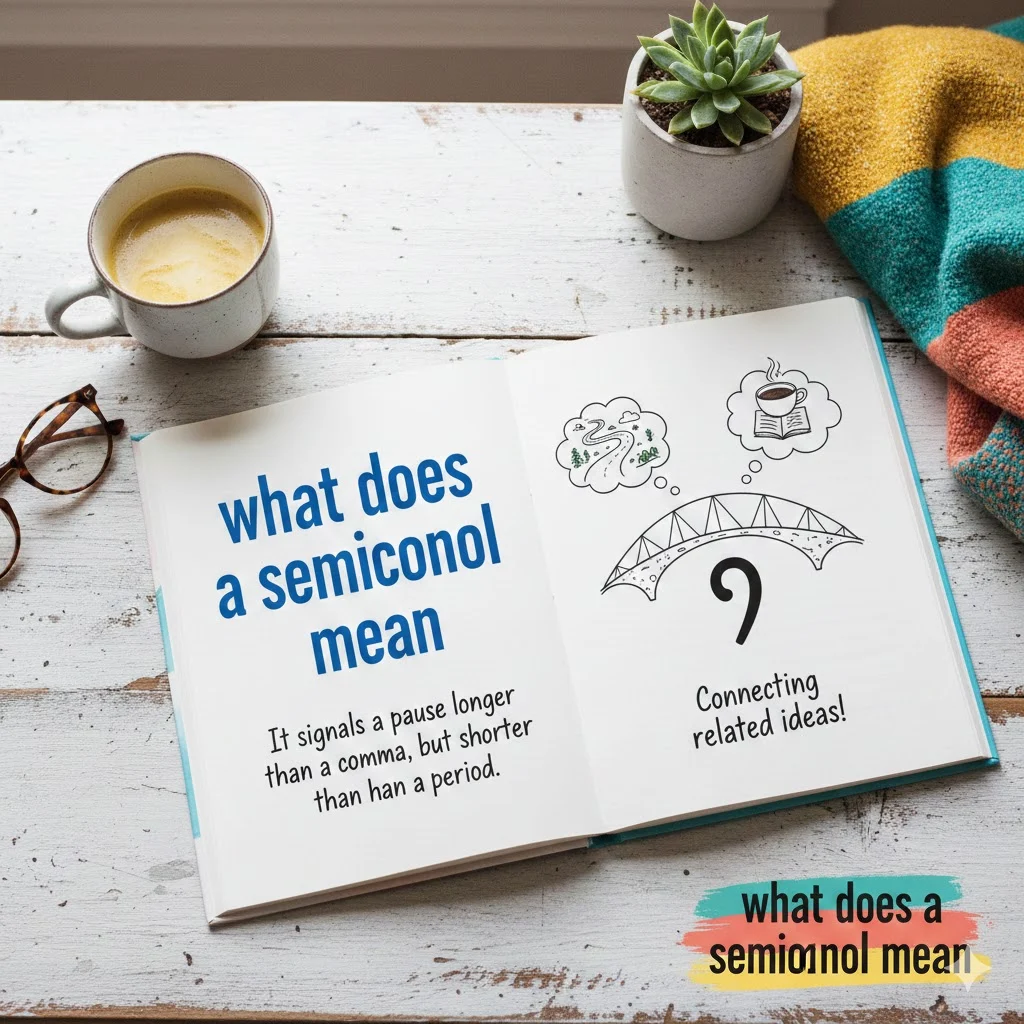
A semicolon is a punctuation mark (;) used primarily to connect closely related independent clauses or to separate items in a complex list.
Key Points:
- Connects related ideas: Links two sentences that could stand alone but are closely connected.
- Separates items in a complex list: Used when list items contain commas.
- Conveys subtle tone: In texting or social media, it can signal a pause, reflection, or emotion.
Examples in Writing:
- I love reading books; my sister prefers watching movies.
- We visited Paris, France; Rome, Italy; and Berlin, Germany.
Examples in Texting or Online Chat:
- “I tried to finish my work today; but honestly, I got distracted 😅”
- “It’s complicated; I’ll explain later.”
Quick Tip: A semicolon is stronger than a comma but weaker than a period.
Background & History of the Semicolon
The semicolon was first introduced in the late 15th century by the Italian printer Aldus Manutius. It was designed to help readers pause in a more flexible way than a period, making texts smoother to read.
- Evolution: Originally used in printed books to break up long sentences.
- Adoption in English: By the 17th century, semicolons became standard in formal writing.
- Modern Usage: Today, semicolons appear in academic writing, professional communication, and even casual texting.
Fun Fact: The semicolon has also been adopted in social movements, such as the Semicolon Project, symbolizing a pause rather than an end in life, especially for mental health awareness.
Usage in Different Contexts
The semicolon is versatile and can be adapted to various communication styles.
Academic & Professional Writing:
- Correct: “The team completed the project on time; however, the client requested additional changes.”
- Incorrect: “The team completed the project on time, however, the client requested additional changes.”
Casual Writing & Texting:
- Can indicate a pause, subtle humor, or sarcasm.
- Example: “I could go to the gym; or I could binge-watch Netflix all day 😏”
Complex Lists:
| Sentence | Correct Usage | Notes |
|---|---|---|
| Travel | “We visited London, England; Paris, France; and Rome, Italy.” | Semicolons separate list items containing commas |
| Shopping | “I bought apples, red and juicy; oranges, sweet and tangy; and bananas, ripe and soft.” | Clarifies each item distinctly |
Semicolon in Professional Communication
While the semicolon is a powerful punctuation tool, misusing it in professional contexts can reduce clarity.
Do’s:
- Use semicolons to connect closely related independent clauses.
- Use in complex lists for clarity.
Don’ts:
- Avoid using semicolons to connect unrelated ideas.
- Don’t overuse; simplicity is often preferred in business emails.
Example Professional Email:
“Please review the attached report; provide feedback by Friday; and update the project tracker accordingly.”
Alternative: Split into shorter sentences if clarity is more important:
“Please review the attached report. Provide feedback by Friday. Update the project tracker accordingly.”
Hidden or Misinterpreted Meanings
Semicolons can sometimes be misunderstood, especially in digital communication.
- Texting & Messaging: Can signal a pause, sarcasm, or hesitation.
- Misinterpretation: Without context, “I’m fine;” might seem curt or serious.
Examples:
- Ambiguous: “I guess we can meet later;” → tone unclear.
- Clearer: “I guess we can meet later; let me know what time works for you.”
Tip: Combine with emojis or follow-up sentences to clarify tone.
Usage in Online Communities & Social Media
Semicolons are surprisingly popular in blogs, online posts, and social media captions:
- Indicates reflective pauses or subtle humor.
- Often paired with emojis to show emotion.
Example Dialogues:
Alex: “I tried cooking tonight; disaster ensued 😂”
Jamie: “Same here; I burned the toast 😅”
In forums or group chats, semicolons can also help structure long, detailed posts for readability.
Comparison with Similar Punctuation Marks
| Punctuation | Meaning | Usage | Tone |
|---|---|---|---|
| Semicolon (;) | Connects related clauses; separates complex list items | Writing, emails, texts | Neutral to subtle |
| Period (.) | Ends a sentence | All writing contexts | Strong, final |
| Comma (,) | Separates items or clauses | Writing, casual communication | Soft, pauses |
| Colon (:) | Introduces a list or explanation | Writing, professional | Formal, informative |
Key Insight: Semicolons combine the strength of a period with the flexibility of a comma, making them unique.
10 Common Mistakes with Semicolons
- Using a semicolon instead of a comma before conjunctions like and or but.
- Splitting unrelated clauses with a semicolon.
- Overusing semicolons in short sentences.
- Using semicolons in place of colons for lists.
- Ending a sentence with a semicolon instead of a period.
- Forgetting to capitalize the next independent clause in some styles.
- Using semicolons with incomplete clauses.
- Confusing semicolons with commas in casual texting.
- Ignoring tone in digital messages.
- Not pairing semicolons with emojis or context in informal chats.
How to Respond or Use Semicolons in Text
Casual Use:
- “I can’t believe this happened; lol”
- “I guess it’s fine; 😅”
Professional Use:
- “Please review the draft; submit your feedback by Monday.”
Humorous/Fun Use:
- “I tried cooking; almost burned the kitchen down 😂”
Regional & Cultural Differences
- US vs UK: Similar formal rules, but British English sometimes prefers slightly longer clauses before semicolons.
- Non-native speakers: Often confuse semicolons with commas, causing errors.
- Digital Culture: Emojis combined with semicolons can completely change the tone.
Example:
US teen: “I went shopping; and bought snacks 😏”
Non-native: Might pause incorrectly or misread tone.
FAQs
Q1: Can I use a semicolon in casual texting?
A: Yes, but make sure the tone is clear; emojis help.
Q2: Is it okay to start a sentence after a semicolon with a lowercase letter?
A: Generally, no. Capitalize the first letter of the independent clause.
Q3: Can semicolons replace periods?
A: Only to connect closely related independent clauses.
Q4: Does semicolon usage vary by region?
A: Slightly, especially between American and British English.
Q5: Are there digital trends involving semicolons?
A: Yes, pairing semicolons with emojis or using them in reflective social media captions.
Q6: Can a semicolon convey emotion?
A: In texting and social media, yes—often a pause, hesitation, or subtle sarcasm.
Conclusion
The semicolon is a powerful, versatile punctuation mark that connects ideas, organizes complex lists, and can even convey subtle emotion in texting and online communication. Understanding what a semicolon means enhances your writing, improves readability, and ensures clarity in professional and casual settings. Whether in academic papers, business emails, or playful social media captions, using semicolons correctly shows attention to detail and enhances your communication skills. Practice, context, and thoughtful usage will make this punctuation your ally rather than a source of confusion.